Celebrate St.
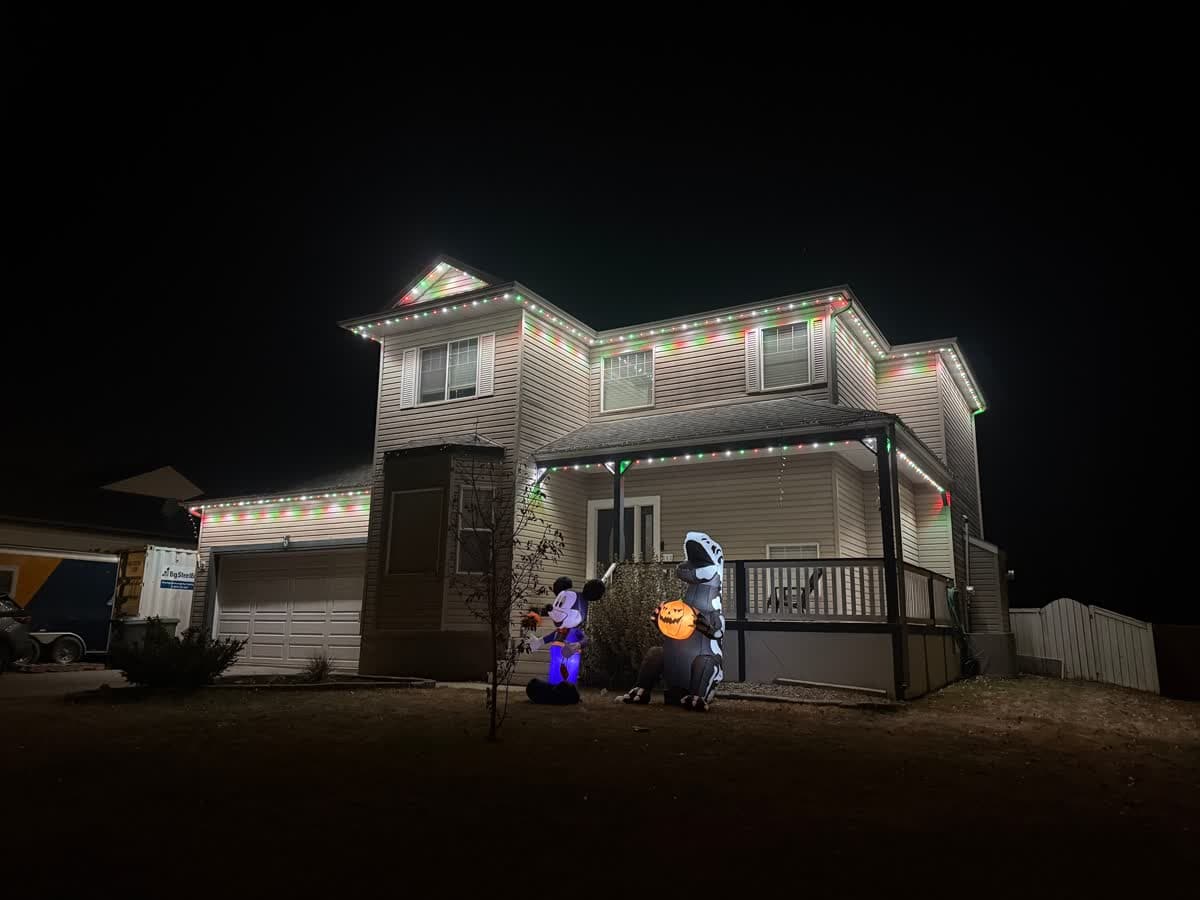 From our gallery
St. Patrick's Day, celebrated every March 17, honours Saint Patrick — the 5th century missionary credited with bringing Christianity to Ireland and, according to legend, using the shamrock to explain the Holy Trinity. What started as a religious feast day evolved over centuries into a global cultural celebration of Irish heritage, Irish music, Irish food, and the wearing of the green. In Calgary, the Irish-Canadian community is woven through the city's history — from early settlers to today's pubs, dance schools, and the annual St. Patrick's Day parade that turns 17th Avenue into a sea of emerald every March.
This guide covers the most popular St Patrick's Day light designs for permanent outdoor lighting systems, including the signature emerald wash, green and gold shamrock palettes, the Irish tricolour, app setup walkthroughs, and design ideas for every home style — with a particular eye on homeowners in Calgary, Airdrie, Cochrane, Okotoks, and across the surrounding communities.
For a quick look at how app-controlled patterns work, explore our Designs page and the live GOULY app preview.
Why St. Patrick's Day is well-suited to permanent lights
St. Patrick's Day lighting is one of the easiest, most rewarding holiday displays of the year. Permanent outdoor lights are uniquely suited to it:
- Long evening visibility. March 17 sits in early spring, with Calgary sunsets landing around 7:30 PM and dusk lingering until almost 8:30 PM. Your St Patrick's Day outdoor lights get a long, generous window to be seen by neighbours coming home from work, walking dogs, or heading out for a pint.
- No inflatables, no plastic leprechauns. Permanent lights let you celebrate St. Paddy's Day with a clean, intentional palette — no inflatable leprechauns on the lawn, no plastic shamrock garlands, no clearance-aisle decor. Just colour, scale, and presence.
- Instant green palette swap. Switching from your everyday warm white to a full green outdoor lights scene takes seconds in the GOULY app. There is no ladder, no clips, no storage bin. One tap and your home is dressed for the holiday.
- Runs the week of March 17. Most homeowners run their St Patrick's Day permanent lights from mid-week to the weekend after — a 5 to 7 day window where green roofs feel festive without overstaying. With permanent lights, that quick window is effortless.
Top St. Patrick's Day light colour patterns
These are the most popular St Patrick's Day permanent lights patterns homeowners run to celebrate March 17:
1. The signature emerald wash (all-green at 100 percent)
The signature St Paddy's Day lights look. Every node across your full roofline set to a deep, saturated emerald green. Simple, bold, and unmistakable — you can see this scene from three blocks away.
- Pattern: Solid emerald green across the entire roofline
- Mode: Static
- Best for: Every home style. This is the foundational St. Patrick's Day display.
- App setup: Set all nodes to Green at 100 percent saturation. Resist the urge to dial it back — emerald reads better than mint at full brightness.
This is the pattern we recommend to most homeowners. A full emerald wash turns your home into an emerald house lights centerpiece for the block, and it works equally well on a bungalow, a two-storey, or an estate. If you only run one St. Patrick's Day scene, run this one.
2. Green and gold lucky shamrock (1 Green, 1 Gold alternating)
A celebratory variation that pairs emerald green with a warm gold accent. One green node, one gold node, alternating across the eave line. The gold evokes "pot of gold at the end of the rainbow" and adds a lucky, festive warmth that pure green cannot deliver on its own.
- Pattern: Green, Gold, Green, Gold (alternating)
- Mode: Static or very slow crossfade
- Best for: Homes hosting St. Patrick's Day gatherings, family parties, or pub-style dinners
- App setup: Two-node alternating pattern: Green at 100 percent, Gold dialled to a warm amber (not a sharp yellow)
The trick with green and gold is keeping the gold genuinely warm. A cold, sharp yellow reads as caution-tape rather than leprechaun gold. Dial it toward amber and you get the classic shamrock lights look that feels rooted in Irish tradition.
3. Tricolour of Ireland (Green, White, Orange repeating)
The Irish flag — green, white, and orange — translated directly onto your eave line. One green node, one white node, one orange node, repeating across the full roofline. The most direct visual reference to Ireland itself.
- Pattern: Green, White, Orange, Green, White, Orange (repeating)
- Mode: Static
- Best for: Homeowners with Irish heritage who want to fly the flag, or homes hosting more traditional St. Patrick's Day gatherings
- App setup: Three-node repeating pattern: Green at 100 percent, White at 85 percent, Orange at 95 percent
To keep this from reading as a generic "autumn" palette, lean into saturation on the green and orange. The white serves as the bright divider that locks the tricolour rhythm in place. This is the go-to Irish tricolour lights pattern.
4. Green chase animation ("the Dublin jig")
All-green palette but animated. Every node runs emerald green, and a chase pattern sends a brighter "pulse" travelling across the roofline at a steady tempo — like a dancing jig moving across the front of the house.
- Pattern: Solid green with a chase highlight animation
- Mode: Chase, medium speed (around 4 to 6 seconds per full pass)
- Best for: Homes hosting St. Patrick's Day parties, or homeowners who want movement without changing palette
- App setup: Set base colour to Green at 70 percent, chase highlight to Green at 100 percent, direction left-to-right
The motion catches the eye without breaking the Irish heritage lights palette. It is the pattern most often paired with parties and the one neighbours tend to remember.
5. Pot of gold (warm gold accent on one section, green elsewhere)
A storytelling pattern. Most of your roofline runs full emerald green, but one short section — usually above the front door or one gable end — runs warm gold. The visual effect is a literal "pot of gold" anchor point on the house.
- Pattern: Green across most of the roofline; one focal section in warm gold
- Mode: Static
- Best for: Homes with a distinct entryway, gable, or architectural focal point
- App setup: Group all nodes as Green, then override one zone (typically 8 to 12 nodes above the front door) to Gold at 95 percent
This works especially well on craftsman and character homes where there is a strong architectural element to anchor the gold against. It is one of the most photographed St Patrick's Day light designs because of the storytelling.
6. Subtle clover (green with warm white interstitials)
A softer take for homeowners who want to nod to the holiday without going full emerald. Two green nodes, one warm white node, repeating. The white breaks up the green just enough to feel intentional rather than overwhelming.
- Pattern: Green, Green, Warm White, Green, Green, Warm White (repeating)
- Mode: Static
- Best for: Estate homes, condos, or homeowners who prefer a restrained palette
- App setup: Three-node repeating pattern: Green at 100 percent, Green at 100 percent, Warm White at 75 percent
This is the pattern for households where one partner wants full St. Patrick's Day and the other wants subtle. It threads the needle.
St. Patrick's Day designs by home style
| Home style | Recommended pattern | Why it works |
|---|---|---|
| Bungalow | Signature emerald wash | A single saturated colour reads beautifully across a long, low roofline |
| Two-storey | Green chase animation (Dublin jig) | Motion adds energy across two storeys without breaking the green palette |
| Craftsman or character | Pot of gold with green elsewhere | Gold accents complement traditional wood, brick, and gable architecture |
| Estate or luxury | Subtle clover (green with warm white) | Restrained palette suits large homes where full emerald can overwhelm |
| Condo or townhome | Green and gold lucky shamrock | Two-colour alternating pattern reads cleanly on shorter eave runs |
How to set up St. Patrick's Day scenes in the GOULY app
Setting up a St. Patrick's Day lighting scene takes about 2 minutes. Here is the flow:
- Open the GOULY app and navigate to your home profile
- Find the folder you want to edit or create a new one (e.g. "St Patrick's Day" or "March Holidays")
- Choose your scene from the folder or create a new scene
- Set your pattern to the signature emerald wash, the green and gold lucky shamrock, or one of the other patterns above
- Set the animation mode (static for the emerald wash and tricolour, chase for the Dublin jig, slow crossfade for green and gold)
- Set a schedule so lights turn on at sunset and off at your preferred time (most homeowners run until midnight on the 17th, then until 10 or 11 PM on adjacent days)
Controller / App
Switch patterns in the comfort of your home
Every scene, colour, and schedule runs from your phone, no clips, no climbing.
Most-used scenes
Try the live preview
See colours and patterns before you commit.
Pro tips for St. Patrick's Day lighting
- Start green on March 15. Most homeowners ramp into the holiday a day or two early. A soft green accent on March 15 builds anticipation, then the full emerald wash hits on March 16 and peaks March 17.
- Peak on the 17th. March 17 is the day. Run the boldest version of your scene that night — full emerald, full saturation, full duration. Schedule the lights to stay on until midnight at minimum.
- Fade out by March 19. By the weekend after, most neighbourhoods have moved on. Drop the scene by March 19 and either return to everyday warm white or transition into early spring pastels for Easter prep.
- Saturated emerald reads better than mint. This is the single biggest mistake homeowners make. A pale, washed-out green looks like a mistake from the street. Dial the green to 100 percent saturation and a deep emerald hue — that is the colour that says St. Patrick's Day.
- Save it as a folder. Save your St. Patrick's Day scene in a dedicated folder so it loads instantly every March. The holiday is annual and recurring — set it up once and reuse it forever.
Irish tricolour vs green-only: choosing your palette
The two main palette choices for St. Patrick's Day come down to flag vs party. Both are valid — the right one depends on what you want the display to say.
The Irish tricolour (green, white, and orange) is the actual national flag of Ireland. It carries history and weight: the green represents Irish Catholics and the Republican tradition, the orange represents Irish Protestants and the Orange Order, and the white between them represents peace between the two. If your family has direct Irish heritage, or you want your Irish heritage lights to make a serious cultural statement, the tricolour is the right call.
Green-only (the emerald wash, the lucky shamrock, the Dublin jig chase) is the casual, party-night look. It says "we are celebrating St. Patrick's Day" without making a constitutional statement. For most homeowners — including those without direct Irish heritage who still love the holiday — green-only is the friendlier, more universally readable choice.
Neither is wrong. The tricolour is more dignified and rooted in Ireland itself. Green-only is more festive and pub-night. Pick the one that matches the vibe you want your home to project on March 17.
Celebrating Irish heritage with intention
Permanent lights are visible to everyone walking past your home, which is why the way you light St. Patrick's Day matters. A few principles homeowners have shared with us:
- Lean into the pub and family tradition. St. Patrick's Day at its best is about gathering — pubs, family dinners with corned beef and cabbage, Irish music, a pint of Guinness, and kids running around in green. Your lights are the visual anchor for that gathering, not the main event.
- Kid-friendly leprechaun traps. If you have young kids, March 16 is leprechaun trap night. A green-lit house with a small "trap" in the yard (a shoebox propped with a stick, gold coins inside) becomes a magical setup for kids. The permanent lights do the heavy lifting on ambience.
- Calgary's St. Patrick's Day celebrations. Calgary's St. Patrick's Day parade and celebrations have a long history in the city, drawing crowds along the parade route and pubs across Inglewood, Kensington, and 17th Avenue. If you are along a parade-adjacent street, your emerald house lights become part of the route's visual energy.
- Support Irish-Canadian community. Calgary has Irish dance schools, Gaelic football clubs, and cultural societies that benefit from donations and volunteer support around the holiday. Use the lead-up to March 17 as a reason to give back to the local Irish-Canadian community in a tangible way.
Lighting is one piece of the story. The rest is what you do with the green glow once the sun goes down.
What colour lights for every spring holiday
One of the biggest advantages of a permanent lighting system is that you are never limited to one holiday. Here is a quick reference for the major spring holidays and the colour patterns that work best:
| Holiday | Colours | Pattern style |
|---|---|---|
| Valentine's Day | Red, pink, warm white | Alternating or gradient |
| Presidents' Day | Red, white, blue | Static |
| Mardi Gras | Purple, green, gold | Chase or alternating |
| St. Patrick's Day | Emerald green, gold, optional Irish tricolour | Static, chase, or alternating |
| Easter | Pastel lavender, pink, mint, yellow | Slow crossfade |
| Mother's Day | Soft pink, lavender, warm white | Slow crossfade |
| Cinco de Mayo | Red, white, green (Mexican flag) | Static or alternating |
St. Patrick's Day sits in a sweet spot in the spring calendar — late enough that winter scenes feel stale, early enough that Easter pastels would feel premature. The emerald palette gives March its own visual moment.
How long should you run St. Patrick's Day lights?
Most homeowners start their St. Patrick's Day lighting scene on March 12 or 13 and keep it running through March 19. That gives the holiday a full week of visibility with March 17 as the peak night.
A suggested timeline around St. Patrick's Day:
| Period | Suggested scene |
|---|---|
| March 12 to 13 (prep) | Soft green accent — warm white base with every fifth node emerald |
| March 14 to 16 (build) | Subtle clover (2 green, 1 warm white) or green and gold alternating |
| March 17 (peak) | Full emerald wash at 100 percent, or the Dublin jig chase animation |
| March 18 (carry-through) | Green and gold lucky shamrock — celebratory but stepping down from peak |
| March 19 (fade) | Single accent green nodes against warm white, then off |
| March 20 onward | Transition to spring warm white or early Easter pastels |
The beauty of permanent lights is that each transition takes seconds in the app. There is no reason not to honour St. Patrick's Day with a full week of intentional lighting even if your everyday scene is something completely different.
Cost of St. Patrick's Day lighting
If you already have a permanent lighting system installed, running St Patricks Day outdoor lights costs nothing extra. There is no new hardware, no decor budget, no seasonal install fee. You use the same system you use for Christmas, everyday curb appeal, and every other occasion across the year.
If you do not have permanent lights yet, a St. Patrick's Day-ready system is the same as any other permanent lighting install — and our RGBW LED puck lighting covers every colour palette you will ever need, including the deep emerald greens and warm golds that make St. Patrick's Day work:
| Home type | Typical installed range (CAD) | St. Patrick's Day ready? |
|---|---|---|
| Bungalow (~150 ft) | $2,500 to $3,000 | Yes, RGBW with full app control |
| Two-storey (150 to 200 ft) | $3,000 to $4,000 | Yes, RGBW with full app control |
| Large or estate home (250 to 400 ft) | $4,000 to $5,000 (larger estates quoted individually) | Yes, RGBW with full app control |
Every system we install includes RGBW nodes with individually addressable control, which means St. Patrick's Day greens and golds, Christmas palettes, Halloween oranges, Easter pastels, and everyday warm white are all included from day one.
St. Patrick's Day light ideas you can steal
Here are specific, ready-to-use St Patrick's Day light designs homeowners love:
The Emerald Isle Solid emerald green across the entire roofline at 100 percent saturation. Static mode. The foundational St. Patrick's Day scene — bold, unmistakable, and visible from three blocks away. Pair with a single green porch light for a unified glow that says March 17 from the curb.
The Lucky Shamrock Green and gold alternating across the full eave line — one green node, one warm gold node, repeating. Static mode, gold dialled to a deep amber tone. Designed for homes hosting St. Patrick's Day dinners, family gatherings, or kid-friendly parties where you want a warm, celebratory feel rather than the bold emerald wash.
The Dublin Jig Chase All-green palette with a chase animation moving left-to-right across the roofline at a 5-second per pass tempo. Base nodes at 70 percent, chase highlight at 100 percent. The motion catches the eye without breaking the green palette — perfect for parties or homes along a busy street.
The Pot of Gold Full emerald green across the roofline with one focal section (typically the 8 to 12 nodes above the front door) overridden to warm gold. Static. A literal "pot of gold at the end of the rainbow" anchor point that turns the entryway into a photographable focal point.
The Tricolour Green, white, and orange repeating across the full roofline — the Irish flag, node by node. Static. The most historically rooted of the St. Patrick's Day scenes. Best for homeowners with direct Irish heritage who want a serious, dignified cultural statement.
Beyond St. Patrick's Day: spring transitions
Once March 17 wraps and the green fades out by March 19, your home is heading into early spring and Easter season. Here are natural transitions:
- Emerald wash to Easter pastels (drop the saturation, swap green for soft lavender, pink, and mint — see our outdoor Easter light designs guide)
- Green and gold to spring warm white (calm, neutral curb appeal for late March before Easter prep begins)
- Irish tricolour to spring colour wash (keep the three-node rhythm but swap to pastel lavender, white, and soft yellow)
- Dublin jig chase to gentle spring crossfade (carry forward the motion but soften the palette into pastels)
Your St. Patrick's Day folder lives in the app library right alongside Christmas, Easter, Valentine's Day, Canada Day, and everyday. One tap to switch, no ladder, no clips, no storage boxes.
The spring colour palette runs from the saturated emerald of mid-March, through pastel Easter at the start of April, into the soft pinks and lavenders of Mother's Day in May. Permanent lights let you walk through the entire spring season without ever climbing a ladder.
Questions about St. Patrick's Day lighting
If you are new to permanent lighting or just installed your system, here are common questions homeowners ask before setting up St. Patrick's Day scenes:
- Should I use saturated emerald or a softer mint green? Saturated emerald, every time. A pale or mint green washes out from the street and reads as "the lights are dimmed" rather than "this is St. Patrick's Day." Dial the green to 100 percent saturation and a deep emerald hue — that is the colour that lands.
- Can I add white nodes to my green-only scene? Yes, and the subtle clover pattern (2 green, 1 warm white repeating) is one of the most popular variations. Just make sure the white is warm (around 2700K to 3000K) rather than cool — cool white against emerald reads as Christmas, not St. Patrick's Day.
- What about kids' party scenes? The Dublin jig chase is the kid favourite. Motion across the roofline is mesmerising for young kids, and pairing it with a leprechaun trap in the yard makes March 16 night magical. For older kids, the pot of gold scene with a "trap" near the front door is a great photo setup.
- Do all greens look the same on LEDs? No. LEDs can render anywhere from a yellow-green (which reads as lime) to a blue-green (which reads as teal) to a true emerald. The right St. Patrick's Day green sits slightly toward the blue side of pure green — deep, rich, and saturated. The GOULY app lets you fine-tune the hue if your default green is reading too warm or too cool.
- Can I save my St. Patrick's Day scene for next year? Yes. Save it in a folder and it is ready to load every March. The holiday is recurring and predictable — set it up once and reuse it forever. Most homeowners refine their scene over a few years until they land on the exact emerald, schedule, and animation they love.
Ready to light up your home for St. Patrick's Day and every occasion?
Frequently asked questions
Saturated emerald green is the signature St. Patrick's Day colour. For a more dignified version, use the Irish tricolour (green, white, orange) which honours the actual flag of Ireland. Gold accents read as 'pot of gold' and add warmth to the green palette.
St. Patrick's Day is observed on March 17 every year — the traditional death date of Saint Patrick, the patron saint of Ireland. It became a major cultural celebration of Irish heritage in Irish-American and Irish-Canadian communities.
Start your St. Patrick's Day scene on March 12 or 13, peak it on March 17 itself, and fade out by March 19. Many Calgary homeowners run their green display through the city's St. Patrick's Day parade weekend.
Yes. Set your green nodes to 100 percent saturation for a true emerald that reads unmistakably 'St. Patrick's' from the street. Mint or pale green reads as Easter or spring — save those for April.
Yes. Any RGBW permanent lighting system produces vivid emerald green, gold, and warm white for tricolour displays. Save a St. Patrick's Day folder in your app and pull it up every March in seconds.
Questions before you book?
Visit our FAQ page
Get quick answers on Gen 3 Lighting, pricing, install timelines, app setup, warranty, and what to expect on install day.