Warm white lighting is the term used for white light produced at a low color temperature, typically between 2700K and 3000K on the Kelvin scale. It is the soft, yellow-tinted, candle-like glow that most people associate with cozy indoor lamps, residential porch lights, and traditional incandescent bulbs. On the outside of a home, warm white is the most flattering, most timeless, and most architecturally appropriate choice for everyday year-round lighting.
This guide explains exactly what 2700K and 3000K warm white lighting are, how they look in the real world, where each color temperature is used, and how a permanent outdoor lighting system like ours produces a true, clean warm white at the push of a button.
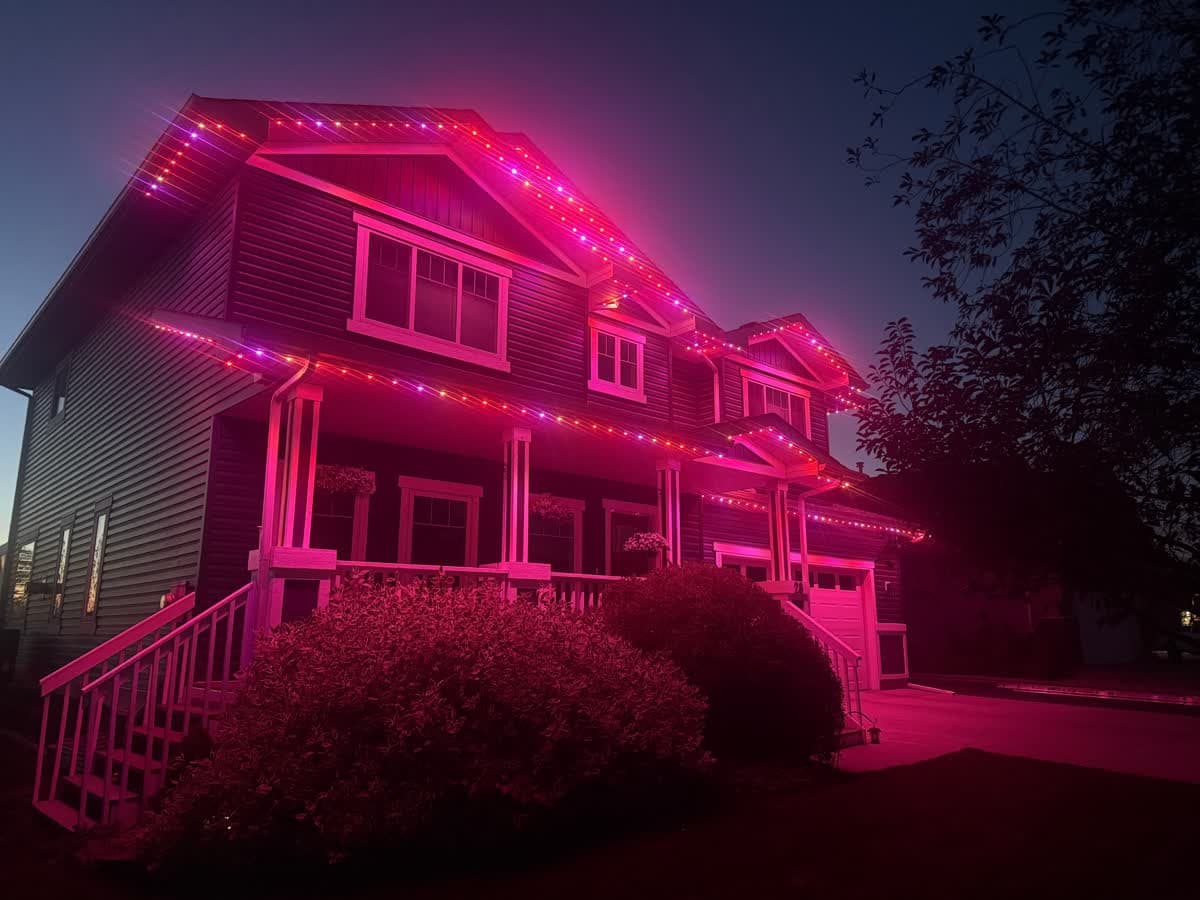
Warm white lighting definition
Warm white lighting is a light source whose color temperature — also called Correlated Color Temperature (CCT) — falls between approximately 2700 Kelvin (2700K) and 3000 Kelvin (3000K). CCT measures the color appearance of a light source on a Kelvin scale that runs from warm (orange-yellow) to cool (blue-white). The lower the number, the warmer and more amber the light appears. The higher the number, the cooler and bluer it appears.
The Kelvin scale is named after the filament temperature of an old incandescent bulb: a tungsten filament heated to about 2700 degrees Kelvin glows with the soft, amber tone we now call "warm white." That is why 2700K is also commonly labeled "soft white" on retail packaging — it is the LED equivalent of a traditional 60-watt incandescent bulb. 3000K is often labeled "warm white" or sometimes "bright warm white", and it matches the cleaner tone of a halogen bulb.
Anything below about 2700K (1800K–2400K) is considered "very warm" or "candlelight" — the dim, deeply amber glow of a fireplace, candle, or filament Edison bulb. Anything from 3500K up moves into "neutral white" and then "cool white" territory, with 5000K to 6500K producing the harsh, blue daylight tone seen in office buildings, gas stations, and parking lots.
Warm white sits in the middle: warm enough to feel inviting and natural, but bright and clean enough to actually illuminate a space. This is why it is the default for living rooms, restaurants, hotel lobbies, residential landscape lighting, and permanent outdoor LED on the exterior of a home.
Where warm white sits on the full Kelvin scale
| Kelvin | Name | Looks like |
|---|---|---|
| 1800–2400K | Candlelight / ultra-warm | Candle, fireplace, sunset |
| 2700K | Soft white / warm white | Classic incandescent bulb |
| 3000K | Warm white | Halogen bulb, premium residential LED |
| 3500K | Neutral warm | Soft office, retail |
| 4000K | Neutral / "cool white" | Modern kitchen, commercial |
| 5000K | Daylight | Gas station, big-box store |
| 6500K | Cool daylight | Industrial, sports stadium |
For residential outdoor lighting, 2700K and 3000K are the only two color temperatures that look truly residential. Everything from 3500K up reads as commercial.
2700K vs 3000K: what's the difference?
Both 2700K and 3000K are considered warm white, but there is a real, visible difference between them. The gap is small (300 Kelvin) but trained eyes pick it up instantly, especially when the two are side by side.
2700K — the traditional warm white
2700K is the classic "soft white" tone. It is the color temperature of a standard incandescent light bulb and the warmest of the two warm whites in common use today. It produces a slightly amber, slightly yellow glow that reads as cozy, intimate, and old-world.
Where 2700K is used:
- Living rooms, bedrooms, and dining rooms where comfort matters more than task brightness
- Traditional or heritage home exteriors (brick, stone, stucco, timber)
- Restaurants and hospitality spaces aiming for an intimate mood
- Bedside lamps and accent lighting
- Landscape lighting on mature trees and natural stone
If you want your home exterior to feel like a warm lantern at dusk, 2700K is the right choice.
3000K — the modern warm white
3000K is what most people now call "warm white" by default. It is slightly cooler and slightly cleaner than 2700K, with less yellow and a more neutral feel — still unmistakably warm, but with a touch more brightness and crispness.
Where 3000K is used:
- Modern and transitional home exteriors (clean lines, painted brick, contemporary stucco, dark trim)
- Kitchen and bathroom task lighting where you want warmth without yellowing
- Permanent outdoor LED lighting installed on most newer homes
- Showrooms, retail, and high-end residential lighting design
- Architectural uplighting and façade washing
If you want your home exterior to look bright, polished, and architectural while still feeling residential and welcoming, 3000K is the better choice.
Quick comparison: 2700K vs 3000K
| Feature | 2700K | 3000K |
|---|---|---|
| Common label | Soft white / warm white | Warm white / bright warm white |
| Visual character | Amber, candle-like, cozy | Clean, slightly crisp, residential |
| Best for | Traditional, heritage, intimate | Modern, transitional, architectural |
| Comparable to | Incandescent bulb (60W A19) | Halogen, premium LED |
| Feels like | A lit fireplace | A soft white sunset |
| Most popular in | Landscape lighting, interiors | Outdoor permanent LED, kitchens |
What about CRI?
While color temperature describes what color the light is, CRI (Color Rendering Index) describes how accurately the light renders the true colors of objects under it. A 3000K LED with CRI 95 will make your brick, paint, and stone look exactly the way they look in daylight; a 3000K LED with CRI 70 will distort them and read as cheap. For outdoor residential lighting, look for CRI 90+ at either 2700K or 3000K. Our Gen 3 RGBW pucks use high-CRI warm-white chips so the warm white reads accurate against any home exterior.
Warm white vs cool white
The other major category in residential lighting is cool white, which typically refers to LEDs in the 4000K to 5000K range. Cool white reads as crisp, blue-tinted, and clinical. It is the right choice for commercial security floodlights, garage workshops, and task lighting where color accuracy matters more than mood.
Warm white (2700K–3000K) is almost always the right choice for the exterior of a home. Cool white on a residential roofline tends to:
- Read as commercial or industrial rather than residential
- Fight with the warm tones of brick, wood, and incandescent interior light visible through windows
- Look harsh in real estate and listing photos
- Disturb circadian rhythm more than warm white in the evening hours
The only places cool white belongs on a home are dedicated security floodlights at side and back entry points, and detached workshop or garage exteriors. The front-facing architectural lighting should always be warm white.
Why 3000K is the most-searched color temperature
When homeowners search for "3000K color temperature warm white lighting", what they are really asking is: which white tone should I put on my house?
3000K has become the de facto standard for outdoor residential LED for three reasons:
- It is warm without being yellow. 2700K can read as too amber on white, gray, or modern home exteriors, washing out paint colors. 3000K stays warm but reads closer to "true white" against modern siding and stone.
- It pairs cleanly with daylight and moonlight. At dusk and into evening, 3000K reads as a natural extension of golden-hour light, rather than fighting it.
- It is what high-end residential designers specify. Most builder spec sheets for new luxury homes call for 3000K LED at the exterior. When you copy what designers choose, your home looks intentional.
This is why every permanent LED system we install can output true 3000K warm white as a one-tap preset — not a vague yellow approximation, but a real, calibrated 3000K tone produced by a dedicated warm-white LED chip.
How permanent LED produces real warm white
Most older permanent lighting systems are RGB only (red, green, blue). On paper, mixing those three should produce white — but in practice, the result is a sickly purple-blue-pinkish tone that does not look like clean white at all. This is the biggest visual giveaway of a budget RGB system: the "warm white" setting looks dirty, off, or oddly cool.
Our system uses RGBW — red, green, blue, plus a dedicated warm white LED chip on every single puck. That dedicated chip is tuned to produce a true 3000K warm white tone, the same color temperature used in high-end residential interior lighting. When you tap "warm white" in the GOULY app, the system turns off the RGB mixing entirely and lights the warm-white chip on its own. The result is a clean, even, residential-grade warm white that holds its color from one end of the roofline to the other.
That is also why the same system can do every other color you'd ever want without ever compromising warm white. You get true warm white for everyday curb appeal, plus full RGB for Christmas, Halloween, Canada Day, team colors, and any custom holiday or celebration — all from one system, controlled from your phone.
When to use warm white outside
Warm white is the right outdoor color about 80% of the time. Most homeowners with our system run warm white as their everyday baseline and switch to themed colors only for specific occasions and holidays.
Recommended uses for warm white outdoor lighting:
- Everyday curb appeal, from spring through fall, when you are not running a themed scene
- Daily security lighting — warm white is bright enough to deter, soft enough not to disturb sleep
- Dinner parties, evening entertaining, and patio use — warm white sets the mood without feeling sterile
- Real estate photos and listing day — warm white photographs as elegant and high-end
- Off-season Christmas, when you want roof lights on but not in Christmas mode
- Subtle accent lighting to highlight architectural details like gables, columns, or stonework
For occasion-driven looks (Christmas, Halloween, sports, birthdays, weddings), you switch to a color or pattern in the app. The next morning, one tap takes you back to warm white. This flexibility is the whole point of permanent RGBW lighting — warm white as your default, every other color when you want it.
2700K vs 3000K for your home: how to choose
If you are deciding between 2700K and 3000K for your permanent outdoor lighting, the easiest way to choose is to match the color temperature to your home's architecture and existing interior lighting.
Choose 2700K if:
- Your home is traditional, heritage, log/timber, brick, or stone
- Your interior lamps are clearly amber/incandescent in tone
- You want the warmest, coziest, most lantern-like glow possible
- You live in a wooded or rural lot where a candlelit feel suits the setting
Choose 3000K if:
- Your home is modern, transitional, contemporary, or new-build
- Your interior LEDs are spec'd at 3000K (most new homes are)
- You want warm white that still reads as bright and architectural
- You want your exterior to feel polished and designer-spec'd
When in doubt, go 3000K. It is the most versatile, photographs the best, and matches the color temperature of nearly every other premium outdoor LED installation you'll see on modern homes. Our Gen 3 puck system outputs a calibrated 3000K warm white by default, and you can to see exactly how it will look on your home before committing.
Common warm white mistakes
- Cheap "warm white" from RGB-only systems. If a system doesn't have a dedicated W (white) channel, its warm white setting is a software fake — usually pink, purple, or sickly. Always insist on RGBW.
- Choosing 4000K or 5000K for residential exteriors. These cool tones make a home look like a parking lot. They are right for commercial security lighting and wrong for almost every house.
- Mixing color temperatures along the same roofline. Older systems lose color consistency on long runs; some pucks will read 2900K and others 3200K, giving the roofline a patchy look. Quality 24V architecture and individually addressable pucks solve this.
- Forgetting that warm white photographs warmer than it looks in person. Phone cameras and listing photos exaggerate the amber. 3000K in person looks like 2700K on camera. Choose accordingly.
See warm white in action
The best way to choose between 2700K and 3000K is to look at real homes lit with the system you are considering. Our photo gallery shows permanent LED installations across Alberta in both warm white and themed modes, and our testimonials page includes homeowner photos taken at dusk and after dark — when warm white reads at its best.
If you want a closer look at exactly how the warm-white LED chip is built into every puck and why it produces a clean tone, the Gen 3 RGBW puck deep dive explains the dedicated chip architecture, IP68 sealing, and 24V wiring that make a real 3000K possible. To plan an installation on your own home, — we'll show you a preview in warm white before any work begins.