Clean track lines, consistent LED spacing, hidden wiring, and sealed mounting points. Here is what to look for in a quality permanent lighting installation.
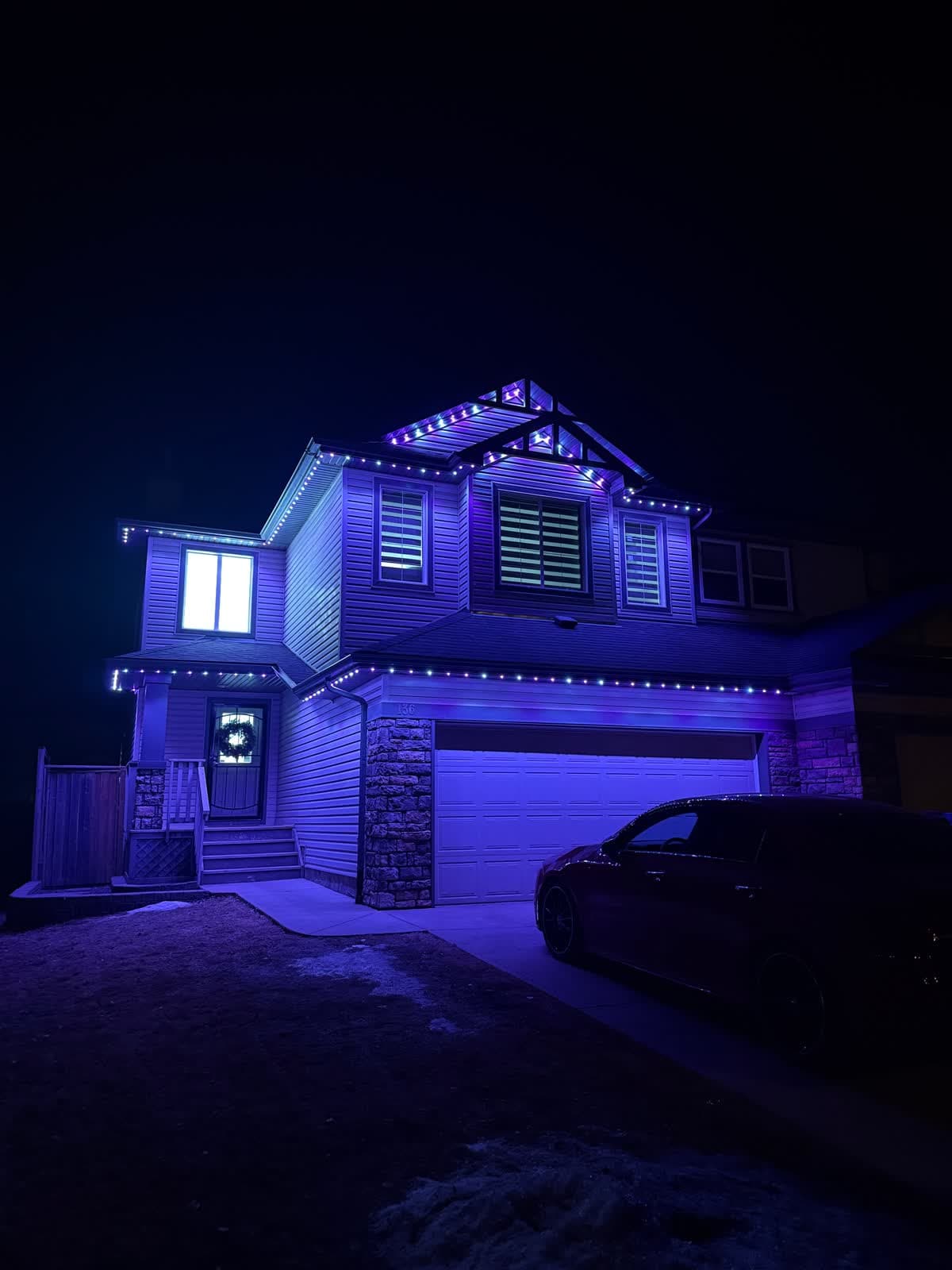 From our gallery
You have seen photos of permanent lighting that looks incredible: clean glowing lines tracing every eave, perfectly even spacing, no visible hardware in daylight. You have also seen installs that look off: crooked track, inconsistent brightness, wires dangling at corners, sloppy transitions at peaks and valleys.
The difference is not the lighting hardware. It is the installation. A quality permanent lighting system installed poorly looks worse than a mid-range system installed well. This guide shows you exactly what a good permanent lighting install looks like, what separates professional work from rushed or amateur jobs, and what our crew standards are at Number One Lights.
Straight track lines
The single most visible sign of a quality install is the track line. When the lights are off during the day, all you see is the aluminum hat track running along your fascia or soffit. If that line is straight, the system looks intentional and architectural. If it wavers, tilts, or has gaps between sections, it looks like an afterthought.
What to look for:
- Continuous, unbroken lines along each roofline segment. The track should run edge to edge without visible breaks or misaligned joints.
- Level mounting. The track follows the fascia line precisely. On older homes where the fascia may have minor imperfections, a skilled installer adjusts the mounting to maintain a visually straight line rather than blindly following a warped board.
- Tight joints. Where two sections of track meet, the joint should be nearly invisible from the ground. No gaps, no overlap, no mismatched angles.
- Colour-matched track. The hat track should be colour-matched to your fascia so it blends in when the lights are off. A white track on brown fascia looks like an add-on, not a permanent feature.
Consistent puck spacing
The RGBW LED puck modules inside the track need to be spaced at consistent intervals for even light output. Uneven spacing creates visible bright spots and dark gaps that are especially noticeable when the lights are set to white.
What to look for:
- Equal distance between every puck along each run. The spacing is determined during system design and should remain uniform throughout.
- No clustering at corners or endpoints. A common amateur mistake is cramming extra pucks near corners or leaving too much gap at the end of a run.
- Consistent brightness from start to finish. On a 24V system, brightness should be uniform across the entire roofline. If the lights are bright near the control box and dim at the far end, the system was wired incorrectly or the wrong voltage was used.
24V
System voltage for consistent brightness
IP68
Weatherproof rating on every LED module
-40°C
Rated operating temperature
Hidden wiring
Wiring should be completely invisible from the ground. Every wire run should be concealed inside the track, behind the fascia, or routed through the soffit. Visible wires are the clearest sign of a rushed install.
What to look for:
- No exposed wires between track sections, at corners, or at the control box entry point.
- Clean entry/exit points. Where wiring enters or exits the track, the transition should be sealed and hidden.
- Wire management at the control box. The certified control box should be mounted in a discreet location with all wiring neatly bundled and protected from weather exposure.
- No wire staples or clips visible from below. The hat track system is designed to contain all wiring internally. If an installer is using external clips or staples, they are not using the track system correctly.
Sealed mounting points
Every screw that goes through your fascia creates a potential moisture entry point. A professional install seals every mounting point to prevent water from getting behind the track and into the fascia material.
What to look for:
- Sealed fasteners. Every screw should be sealed to prevent moisture infiltration. This is especially important on wood and James Hardie fascia where moisture can cause rot or delamination over time.
- No exposed raw edges. Where track is cut to length, the cut end should be clean and finished.
- Weatherproof connections. All electrical connections between track sections and at the control box should use weatherproof connectors rated for outdoor use.
Clean transitions at peaks and valleys
Peaks (where two roofline sections meet at the top) and valleys (where they meet at the bottom) are where most installs fall apart visually. These are the hardest sections to get right and the areas that separate professional crews from amateurs.
What to look for at peaks:
- Tight mitre joints where two track sections meet at the ridge. The angle should match the roof pitch precisely, with no gap visible from the ground.
- Continuous light flow. The puck spacing should remain consistent through the peak, so there is no dark spot or bright cluster at the top.
- No exposed hardware. Junction pieces and connectors at peaks should be hidden inside the track or behind trim.
What to look for at valleys:
- Smooth angle transitions where the track follows the roofline down into a valley and back up the other side.
- No kinks or bends in the track. Aluminum hat track is rigid and needs to be properly cut and joined at angle changes, not forced into a curve.
- Consistent spacing through the transition. The pucks should not skip a beat at the valley.
Other transition points
- Corners. Where the roofline turns a 90-degree corner, the track should meet cleanly with no visible gap.
- Soffit-to-fascia transitions. If the track moves from a soffit section to a fascia section, the handoff should be invisible from the street.
- Gutter lines. The track should run above or behind the gutter line so it does not interfere with water drainage and is not hidden by the gutter from below.
What to look for from the street
A quality install passes the street test. Stand at the curb and look at your roofline. Here is what you should see during the day:
- A clean, straight line of track that blends with the fascia
- No visible wires, connectors, or mounting hardware
- No gaps or misaligned sections
- Track colour that matches the fascia tone
And at night:
- Even, consistent brightness across the entire roofline
- No dark spots at peaks, valleys, or corners
- Smooth colour transitions during animated patterns
- The light should trace the architectural shape of the home, making the structure visible and attractive from the street
| Feature | Many Competitors | GOULY Gen 3 |
|---|---|---|
| Sign | Good install | ✓Poor install |
| Track alignment | Straight, level, continuous | ✓Wavy, tilted, gaps between sections |
| Puck spacing | Uniform throughout | ✓Clustered or uneven |
| Wiring | Completely hidden inside track | ✓Visible wires at corners and transitions |
| Mounting points | Sealed, secure, hidden | ✓Exposed screws, no sealant |
| Peak transitions | Tight mitre joints, no gaps | ✓Visible gaps, exposed connectors |
| Daytime appearance | Track blends with fascia | ✓Track stands out, looks like an add-on |
| Night appearance | Even brightness, no dark spots | ✓Bright and dim areas, flickering |
Our crew standards
At Number One Lights, every installation follows the same standards regardless of home size, roofline complexity, or fascia material.
Before install day:
- Virtual quote includes a detailed review of your roofline, fascia condition, and any special considerations
- System design is finalized with correct puck count, spacing, track lengths, and control box placement
- Materials are prepared and cut to spec before arriving on site
On install day:
- Crew arrives with all materials, tools, and safety equipment
- Every fascia section is inspected before mounting begins
- Track is installed section by section with alignment checks at each joint
- Wiring is routed through the track system with sealed connections
- Pucks are installed at consistent spacing and tested zone by zone
- The control box is mounted, wired, and connected to WiFi
- Full system test: every colour, every zone, every pattern
- Walkthrough with the homeowner to demonstrate the GOULY app and saved designs
After install day:
- Support through the app for design changes, scheduling, and troubleshooting
- Our crew stands behind the work
The goal is a system that looks like it was always part of the house, not something that was added later. That standard applies whether the home is a single-storey bungalow or a multi-level estate.
See real installs
The best way to evaluate installation quality is to see real work. Browse completed Number One Lights installs in our gallery and read what homeowners say on our testimonials page. Every photo in the gallery is an actual customer install, not a manufacturer stock image or a rendering.
Want to see the full system components? Visit our system overview page to understand how the track, LED modules, and control box work together.
Ready to get started? Our virtual quote process is free, no-obligation, and gives you honest pricing with no surprises. Check out the quick start guide to see the full process from first contact to install day.
Frequently asked questions
A quality install has clean, straight track lines with no visible gaps, consistent LED spacing, hidden wiring at transitions, and sealed mounting points. Our crew follows strict standards on every project.
Questions before you book?
Visit our FAQ page
Get quick answers on Gen 3 Lighting, pricing, install timelines, app setup, warranty, and what to expect on install day.