Should you keep hanging temporary Christmas lights every year or invest in permanent outdoor LEDs? This guide compares cost, safety, durability, convenience, and year-round value for Calgary homeowners.
Every fall the same routine starts. Dig out the boxes. Untangle the strings. Test each strand to find the dead bulbs. Climb the ladder, clip them up, and hope the wind does not pull everything down before January.
Temporary Christmas lights have been the default for decades. But permanent outdoor LED lighting has changed the equation entirely. This guide breaks down the real differences between permanent lights vs temporary lights so you can make an informed decision based on actual numbers, not marketing. For the full overview of how permanent systems work, see our complete guide to permanent lights.
The quick comparison
| Feature | Many Competitors | GOULY Gen 3 |
|---|---|---|
| Factor | Temporary lights | ✓Permanent lights |
| Upfront cost | $150 to $300 per season (DIY materials) | ✓$5,500 avg one-time (typical home) |
| Annual cost | $400 to $600 per year (pro install and takedown) | ✓$0 after initial install |
| Lifespan | 1–3 seasons before replacement | ✓50,000+ hours (10–15 years) |
| Install and removal | Every year, ladders and roof work | ✓One-time professional install |
| Colour options | Buy new strings for new colours | ✓16 million+ colours from the app |
| Year-round use | Holiday season only | ✓Holiday, security, architectural, game day, any occasion |
| Weather rating | Consumer grade, limited cold rating | ✓IP68, rated to −40°C |
| Safety | Ladder falls, roof damage, 120V hazards | ✓No ladders, low-voltage 24V, certified hardware |
| Curb appeal off-season | Bare roofline or leftover clips | ✓Clean hidden track with architectural white |
| Control | Manual plug-in or basic timer | ✓App scheduling, dimming, zones, music sync |
The real cost of temporary lights
Most homeowners think of temporary lights as the budget-friendly option. Year one, that is true. But temporary lighting has costs that stack up fast:
- Annual installation fees. Professional hang-and-remove in Calgary typically runs $400 to $600 per year depending on home size and roofline complexity. DIY means your own ladder time, a full weekend, and roughly 80 hours over 10 years.
- Replacement strings. Consumer-grade lights degrade. Faded LEDs, broken sockets, and tangled wiring mean partial or full replacement every one to three seasons at $150 to $300 per round.
- Mid-season repairs. Wind, ice, and Chinook cycles knock strands loose. Getting back on the roof mid-December is nobody's idea of fun.
- Storage. Tangled bins in the garage. Labelling which string goes where. Testing each run before the next season.
- Roof and gutter wear. Clips, staples, and repeated mounting damage shingles, fascia, and eavestrough over time.
Over 10 years, that adds up to $4,000 to $6,000 in total service cost with nothing permanent to show for it.
$4,000–$6,000
10-year cost of temporary lights
$5,500
Avg one-time cost (typical home)
~4 years
Typical break-even point
The real cost of permanent lights
Permanent LED lighting has a higher upfront cost. Here are typical ranges for a professionally installed system:
| Home type | Linear footage | Typical installed price |
|---|---|---|
| Bungalow | Around 150 ft | $4,500 to $5,500 |
| Two storey | 150 to 200 ft | $4,500 to $6,500 |
| Large two storey | 200 to 300 ft | $4,500 to $7,500 |
For a detailed breakdown of what drives pricing up or down, see the what are permanent lights cost section.
That one-time investment includes:
- professional installation with hidden track, sealed wiring, and no visible hardware in daylight
- IP68-rated nodes built for Alberta winters down to −40°C
- app control with 16 million+ colours, scheduling, dimming, zones, and music sync
- 24V architecture for brighter, more consistent output on long runs
- year-round functionality including holidays, architectural white, security lighting, and game day colours
- certified control hardware with proper fusing and protection
- no annual fees for install, removal, or replacement
- warranty coverage on hardware and workmanship
10 year total cost visual
- Temporary hanging lights: ($4,000 to $6,000)
- Permanent system: (~$5,500 one time for typical home)
Break even is commonly around year 4 based on the ranges above. After that, permanent systems keep providing value with no annual reinstall cycle.
| Temporary (cumulative) | Permanent (cumulative) | |
|---|---|---|
| Year 1 | $150–$300 materials + $400–$600 install | $5,500 (one-time) |
| Year 2 | $1,100–$1,800 | $5,500 |
| Year 4 | $2,200–$3,600 | $5,500 |
| Year 6 | $3,300–$5,400 | $5,500 |
| Year 10 | $4,000–$6,000+ | $5,500 |
By year ten you have spent up to $6,000 on temporary lights and you still have to climb the ladder every December. Permanent lights are still running, still covered, and still controlled from your phone.
One season vs all year
This is where the gap gets wide.
Temporary lights are a December thing. Maybe you stretch them into January. Then they sit in a box for eleven months.
Permanent lights work 365 days a year:
| Month | What you can run |
|---|---|
| January–February | Warm white architectural, Valentine's Day pink and red |
| March–April | Easter pastels, spring greens |
| May–June | Warm white curb appeal, game day team colours |
| July | Canada Day red and white |
| August–September | Sunset timers, warm white, back-to-school |
| October | Halloween orange and purple |
| November | Remembrance Day red, then Christmas prep |
| December | Full Christmas display with animations and chase effects |
One system replaces every seasonal lighting decision you will ever make. Browse 1,000+ design patterns or explore the full animations library to see what is possible.
Safety
Temporary light installation is one of the leading causes of fall injuries during the holiday season. Every year across Canada, emergency rooms see a spike in ladder-related injuries tied to holiday decorating.
Beyond ladders, temporary lights carry other risks:
- 120V mains voltage running along wet rooflines
- overloaded extension cords and power bars
- staples through wire insulation creating short-circuit risk
- incandescent bulbs generating heat near dry wood and shingles
| Feature | Many Competitors | GOULY Gen 3 |
|---|---|---|
| Safety factor | Temporary lights | ✓Permanent lights |
| Voltage | 120V mains | ✓24V low voltage |
| Fire risk | Higher (frayed wires, overloaded outlets) | ✓Minimal (sealed, fused, certified) |
| Ladder use | Every install and removal season | ✓Zero after one-time professional install |
| Moisture protection | Clips and staples create entry points | ✓Sealed aluminum track protects the fascia |
| Electrical certification | Rarely | ✓CSA-certified control hardware |
Permanent systems are installed once by professionals with proper safety equipment. After that, everything is controlled from the ground through the GOULY app. Considering a DIY install instead? Read our DIY vs professional install guide first.
Durability and weather
Alberta weather is hard on everything. Chinook swings, freeze-thaw cycles, summer UV, and heavy snow loads.
Temporary lights are not built for this:
- plastic clips crack in deep cold
- strands fade and yellow after one summer of UV
- connections corrode after a single season of moisture exposure
- no formal IP rating for water and dust protection
Permanent LED systems like GOULY Gen 3 are engineered for full-time outdoor exposure:
- IP68 rated for dust and water sealing
- −40°C cold operation for the worst Alberta winters
- UV-stabilized housings that resist fading and cracking for years
- Sealed connectors designed for Chinook freeze-thaw cycles
- 50,000+ hour rated lifespan backed by real hardware specs
- Singular LED modules so a single failed node can be swapped without replacing the whole run
The aluminum mounting track actually protects the fascia it is installed on, instead of damaging it the way clips and staples do.
For a deeper look at what makes permanent lighting durable, see the outdoor LED durability guide.
What does it look like during the day?
One of the most common concerns about permanent lighting is whether it looks awkward in daylight.
The answer is no. Permanent systems use a low-profile aluminum track and small LED puck nodes that virtually disappear against the soffit or fascia. During the day, most people cannot tell the system is there.
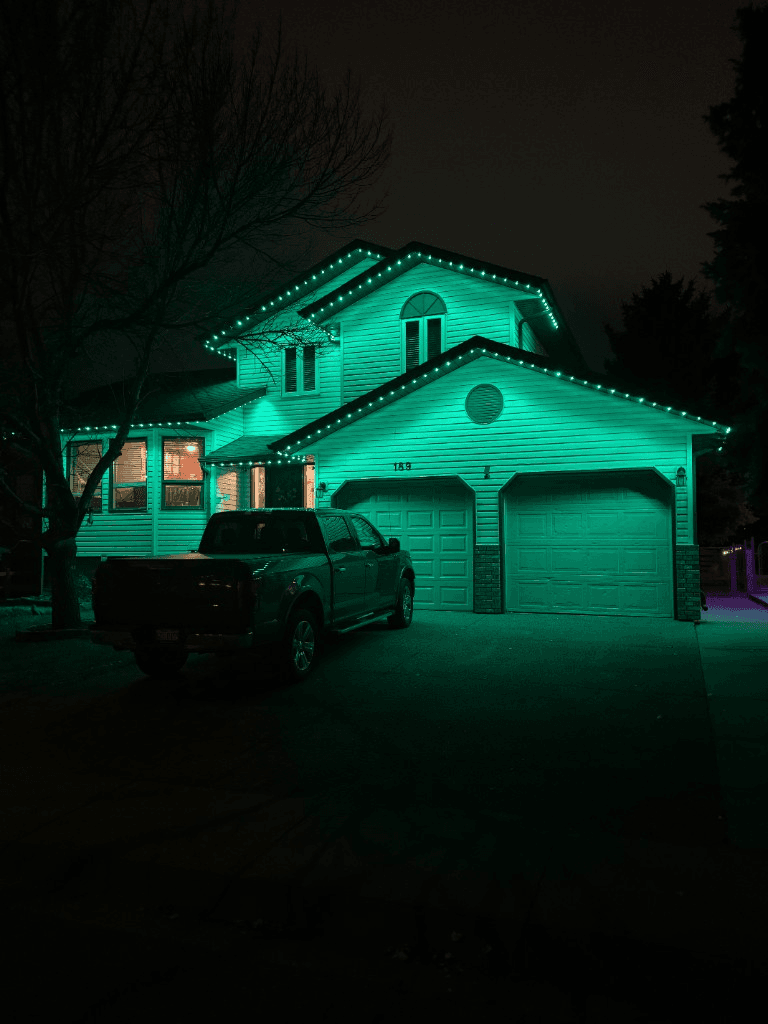
Temporary lights, on the other hand, leave visible wires, clips, and sagging runs even when turned off. And if you leave them up past January, the whole neighbourhood notices. Need help with Christmas light removal in Calgary?
Convenience
With temporary lights, every season means:
- digging out boxes from storage
- testing and replacing dead bulbs
- climbing ladders in cold weather
- spending a full weekend on install
- doing it all again in January to take them down
With permanent lights, you:
- open the GOULY app on your phone
- pick a design or create your own
- tap apply
That is it. Change your entire look in seconds from the couch. Schedule lights to turn on at sunset and off at midnight. Run different colours on each zone. No ladder, no boxes, no wasted weekends. Learn more about how the full GOULY ecosystem works together.
Home value and curb appeal
Permanent lighting is increasingly viewed as a home upgrade, not just decoration. A clean professional installation adds to curb appeal year-round, not just four weeks in December.
Real estate agents in Calgary regularly note that homes with permanent lighting photograph better, show better, and feel more polished to buyers. Warm white architectural lighting running every evening makes a home look premium whether it is listed for sale or not. See what that looks like on real homes in the install gallery.
Environmental impact
Temporary lights create waste every season. Burnt-out strands end up in landfills. Packaging, replacement bulbs, and broken clips add up.
Permanent LEDs are rated for 50,000+ hours. At eight hours per day, that is over 17 years of use. A typical permanent system uses 50 to 150 watts total, roughly the same as a single old incandescent bulb. Less waste, less energy, longer life.
Who should stick with temporary lights?
Temporary lights still make sense in a few situations:
- you are renting and cannot modify the exterior
- you are selling the home within the next year
- you only want lights for a single event and do not plan to decorate again
For everyone else, especially homeowners who plan to stay three or more years, permanent lighting is the better investment by every measure. Still have questions? Check the FAQ.
The bottom line
Temporary lights cost less on day one but add up fast with annual install fees, replacement strings, roof wear, and safety risk.
Permanent lights cost more upfront but eliminate every recurring expense, give you 16 million colours for every occasion, last over a decade, and never require a ladder again.
If you are tired of the annual routine and want lighting that works for Christmas, security, curb appeal, game day, and everything in between, permanent is the clear choice.
See real installs in the gallery, read what homeowners say on our testimonials page, or explore outdoor lighting ideas for seasonal inspiration.
Ready to stop hanging temporary lights every year?
Frequently asked questions
Yes. Temporary lights typically cost $400 to $600 per year for professional installation and takedown alone, plus $150 to $300 in materials. A permanent system averaging $5,500 for a typical home pays for itself in roughly 4 years and then costs nothing to operate year after year.
Yes. Permanent LED systems offer 16 million plus colours through the GOULY app. You can run holiday themes, architectural warm white, security lighting, game day team colours, and custom animations for any occasion, all from your phone.
Yes. GOULY Gen 3 permanent lights are IP68 rated and operate reliably down to minus 40 degrees Celsius. They use low-voltage 24V power with certified control hardware, which is far safer than 120V temporary strings.
No. The low-profile aluminum track and small LED nodes virtually disappear against the soffit and fascia. Most people cannot tell the system is installed during daylight hours.
GOULY Gen 3 LEDs are rated for over 50,000 hours. At eight hours per day, that is over 17 years of use. Temporary strings typically last one to three seasons before needing replacement.
Temporary lights may make more sense if you are renting, selling your home within the next year, or only need lights for a single one-time event. For homeowners staying three or more years, permanent lighting is the better investment.
Questions before you book?
Visit our FAQ page
Get quick answers on Gen 3 Lighting, pricing, install timelines, app setup, warranty, and what to expect on install day.