A permanent LED roofline system uses 50 to 150 watts total, costing about $2 to $5 per month.
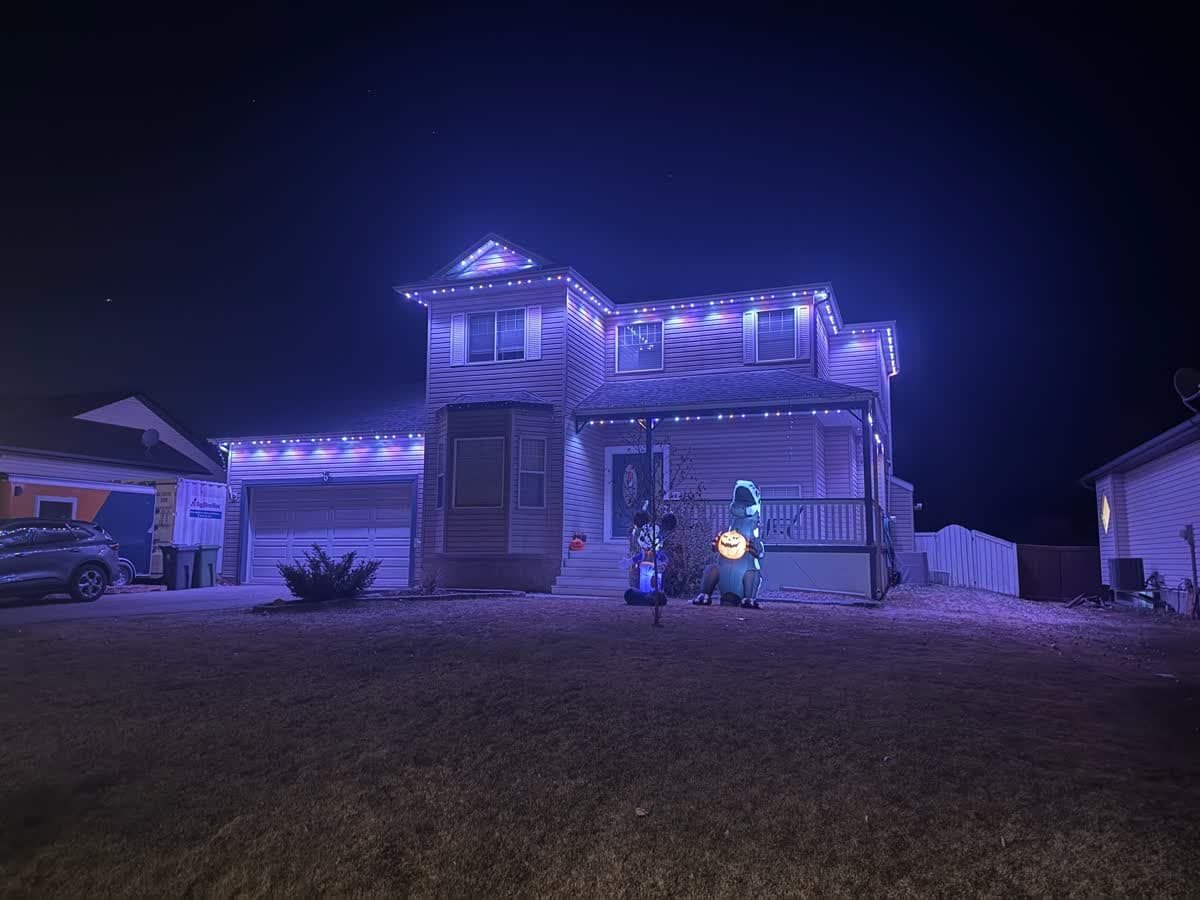 From our gallery
One of the most common questions homeowners ask before investing in permanent outdoor lighting is simple: how much electricity do permanent LED lights use?
The short answer: a typical permanent LED system draws 50 to 150 watts total for a full roofline. That is roughly the same as a single old incandescent bulb. At average Alberta electricity rates running 6 hours per day, that works out to about $2 to $5 per month, or roughly $55 per year for a typical Calgary home.
This guide breaks down the real energy numbers, how permanent LED lighting compares to traditional outdoor lighting, and why features like app-controlled dimming, scheduling, and low-voltage 24V architecture make it one of the most efficient exterior upgrades you can make.
50–150W
Total system draw (full roofline)
$2–$5/mo
Electricity cost at Alberta rates
~$55/yr
Annual cost for a typical home
How much electricity do permanent outdoor LED lights use?
A permanent LED system like GOULY Gen 3 uses individually addressable LED puck modules spaced along your roofline. Each node draws approximately 0.5 watts at full brightness.
Here is what that looks like for a typical home:
| Home size | Approx nodes | Total wattage | Monthly cost (6 hrs/day) | Annual cost |
|---|---|---|---|---|
| Bungalow (150 ft) | ~100 nodes | ~50W | ~$2 | ~$24 |
| Two storey (200 ft) | ~130 nodes | ~65W | ~$3 | ~$36 |
| Large two storey (300 ft) | ~200 nodes | ~100W | ~$4 | ~$48 |
| Estate (400+ ft) | ~270 nodes | ~135W | ~$5 | ~$60 |
Those numbers assume full brightness, full colour, running 6 hours every night. In practice, most homeowners run warm white at partial brightness on weeknights and full colour for holidays, which uses even less.
For context, a single 100W incandescent porch light running 6 hours per day costs more to operate than an entire permanent LED roofline system.
LED vs incandescent vs halogen: the energy comparison
The efficiency gap between LEDs and older lighting technology is massive. According to the U.S. Department of Energy, LEDs use at least 75 percent less energy than incandescent bulbs. In outdoor applications, the difference is even more dramatic because traditional fixtures run at higher wattages.
| Feature | Many Competitors | GOULY Gen 3 |
|---|---|---|
| Factor | Incandescent | ✓Halogen | LED (permanent system) |
| Energy used for same brightness | 60–100W per bulb | ✓40–75W per bulb | 0.5W per node |
| Energy wasted as heat | 90% | ✓80–85% | Less than 10% |
| Lifespan | 750–2,000 hours | ✓2,000–4,000 hours | 50,000+ hours |
| Annual electricity (full roofline) | $300–$600+ | ✓$200–$400+ | ~$55 |
| Bulb replacements per decade | 15–25 per fixture | ✓8–12 per fixture | 0 |
Permanent LED systems use 80 percent less energy than traditional halogen or incandescent outdoor lighting. The savings are not marginal. They are the difference between $300+ per year and $55 per year.
Why permanent LED lights are so efficient
LED efficiency is not just about the bulb. In a permanent system, several factors compound the savings:
Low wattage per node
Each LED puck module draws roughly 0.5 watts. Even a large home with 200 nodes only pulls 100 watts total at full brightness. Compare that to a string of 200 incandescent Christmas bulbs drawing 400 to 800 watts.
Dedicated warm white channel
RGBW systems have a dedicated white LED channel separate from the red, green, and blue channels. When you run warm white, only that single efficient channel fires. Older RGB-only systems had to mix all three colour channels to approximate white, which used more power and produced an inferior colour. The dedicated white diode is both more efficient and more accurate.
Minimal heat waste
Incandescent bulbs convert 90 percent of their energy into heat. LEDs convert most of their energy into light. That means less electricity wasted, less heat stress on housings and wiring, and longer component life. Permanent LED nodes are cool to the touch even after hours of operation.
24V low-voltage architecture
The GOULY system runs on 24V low voltage rather than 120V mains power. Lower voltage means the system draws half the current compared to a 12V system at the same wattage. Less current means less resistive heat loss in wire runs and more energy actually reaching the LEDs as light.
This also means the certified control box runs cooler, the wiring runs cooler, and the system stays more efficient over real-world distances of 150 to 300+ feet.
How app control and scheduling save even more energy
The biggest energy advantage of permanent LED lighting over traditional fixtures is not just the hardware. It is the software.
Sunset and sunrise automation
The GOULY app automatically adjusts your on and off times based on actual sunset and sunrise in your location. No more lights burning at 4 PM in summer when it is still bright out, and no more forgetting to turn them off at midnight. Automation eliminates waste hours that manual switches and basic timers miss.
Dimming
Dimming is one of the most underrated energy strategies for outdoor lighting. The math is straightforward:
- Dimming to 75 percent reduces energy use by roughly 25 percent
- Dimming to 50 percent reduces energy use by roughly 40 percent
- Dimming to 25 percent reduces energy use by roughly 60 percent
Most homeowners do not need full brightness for everyday warm white curb appeal. Running at 50 to 70 percent brightness on weeknights looks great from the street and cuts electricity use significantly. Save full brightness for holidays, game day, or security mode.
Zone control
With quad-zone control, you can run the front of the house at full brightness for curb appeal while keeping the back and sides off or dimmed. No need to light the entire perimeter at the same level all night. Zone control puts energy exactly where it matters.
Scheduling by day of week
Set different schedules for weeknights versus weekends. Run a subtle warm white at low brightness on Monday through Thursday and full colour displays on Friday and Saturday. The app handles it automatically.
The real cost to run permanent LED lights year-round
Here is what a full year of permanent LED lighting looks like on your electricity bill, broken down by seasonal use:
| Season | Typical use | Hours per night | Brightness | Monthly cost |
|---|---|---|---|---|
| January–March | Warm white, 50% brightness | 5 | 50% | ~$1.50 |
| April–May | Spring colours, sunset timers | 4 | 60% | ~$1.50 |
| June–August | Warm white, short evenings | 3 | 50% | ~$1.00 |
| September–October | Halloween, warm amber | 5 | 70% | ~$2.00 |
| November–December | Full Christmas display, animations | 7 | 100% | ~$4.50 |
Estimated annual total: $25 to $55 depending on home size, brightness preferences, and how many hours you run the system.
That includes every occasion, every holiday, every season. Not just Christmas.
Environmental benefits of permanent LED lighting
Energy efficiency is only part of the environmental story:
Reduced waste
Temporary Christmas lights end up in landfills every one to three seasons. Burnt-out bulbs, cracked sockets, and tangled wiring add up fast. A permanent LED system rated for 50,000+ hours lasts 10 to 15 years with zero disposable components. If a single node fails, the singular module design means you swap one puck, not the whole system.
Lower carbon footprint
Less electricity means fewer emissions. Running a permanent LED system at $55 per year versus a traditional setup at $300+ per year means roughly 80 percent less energy pulled from the grid. Over a decade, that adds up to a meaningful reduction in household carbon output.
No toxic materials
Unlike CFL bulbs, LEDs contain no mercury or other hazardous materials. Safe to handle, safe to dispose of, and safe to run on your home year-round.
Reduced light pollution
The GOULY app lets you dim, schedule, and zone your lighting precisely. Instead of blasting full brightness all night, you can run subtle warm white at 30 percent after midnight. Less light where it is not needed means less light pollution for your neighbourhood and local wildlife.
Permanent LED vs temporary Christmas lights: the energy math
The seasonal comparison makes the efficiency case even stronger:
| Factor | Temporary incandescent strings | Permanent LED system |
|---|---|---|
| Wattage for 150 ft of roofline | 300–600W | 50W |
| Monthly electricity (December) | $15–$30 | ~$4.50 |
| Hours typically run per night | 8–12 (no smart scheduling) | 5–7 (automated sunset/sunrise) |
| Forgotten-on waste | Common (no automation) | Zero (app scheduling) |
| Off-season use | None (stored in boxes) | Year-round at minimal cost |
A homeowner running traditional incandescent Christmas lights for 6 weeks uses more electricity than a permanent LED system running year-round. That is not an exaggeration. The wattage difference is that large.
For a full comparison beyond just energy, see our permanent lights vs temporary lights guide.
Tips to maximize energy efficiency with permanent lights
If you want to minimize your electricity use even further:
- Use sunset and sunrise scheduling. Let the app match your lights to daylight automatically instead of running on a fixed timer.
- Dim on weeknights. 50 percent brightness for everyday warm white looks great and uses 40 percent less energy.
- Use zones. Light the front for curb appeal and keep the sides and back off or dimmed when not needed.
- Schedule late-night shutoff. Run lights from sunset to midnight instead of sunset to sunrise. Saves 4 to 5 hours of runtime per night.
- Save full brightness for occasions. Holidays, game day, and parties deserve full power. Tuesday night does not.
- Run warm white daily. The dedicated white channel on RGBW systems is more efficient than full-colour modes.
How permanent LED efficiency compares to solar outdoor lights
Solar landscape lights seem like the ultimate efficiency play since they use zero grid electricity. But they have trade-offs:
- Brightness. Solar lights are dim compared to permanent LEDs. They work for subtle path marking but cannot provide real security illumination or dramatic curb appeal.
- Reliability. Solar panels need direct sun to charge. Alberta's short winter days, cloud cover, and snow-covered panels mean inconsistent performance exactly when you want lights most.
- Lifespan. Solar light batteries degrade in 2 to 3 years. The panels and housings deteriorate in UV and cold. Replacement cycles create waste that offsets the grid-free benefit.
- Control. No app, no dimming, no colour, no scheduling, no zones. They turn on when it gets dark and turn off when the battery dies.
Permanent LED systems draw minimal grid electricity but deliver reliable, controllable, full-colour lighting every single night regardless of weather or season.
The bottom line on energy efficiency
Permanent LED outdoor lighting is one of the most energy-efficient exterior upgrades a homeowner can make. At 50 to 150 watts for a full roofline, it costs less to operate than most people expect, roughly the price of a coffee per month.
Combined with app-controlled dimming, sunset and sunrise scheduling, zone control, and 24V low-voltage architecture, the actual real-world electricity cost is often even lower than the headline numbers.
And unlike any other exterior lighting option, you get year-round curb appeal, holiday displays, security coverage, and game day fun from a single system that uses less power than a laptop charger.
Explore outdoor lighting ideas for inspiration, or check the FAQ for more common questions.
Ready to upgrade to energy-efficient permanent lighting?
Frequently asked questions
A typical permanent LED roofline system draws 50 to 150 watts total. At average Alberta electricity rates running 6 hours per day, that costs about $2 to $5 per month, or roughly $55 per year for a typical Calgary home.
Yes. Permanent LED systems use 75 to 80 percent less energy than incandescent or halogen outdoor lighting. A full permanent LED roofline uses roughly the same wattage as a single traditional light bulb.
Yes. Dimming to 50 percent brightness reduces energy consumption by approximately 40 percent. Most homeowners run everyday warm white at partial brightness and only use full power for holidays and special occasions.
Yes. LEDs produce minimal heat and are designed for extended operation. However, the GOULY app lets you schedule automatic shutoff at midnight or any time, which saves energy without any manual effort.
No. Even at full brightness with colour animations running 7 hours per night, a permanent LED system costs about $4 to $5 per month in electricity. Traditional incandescent Christmas lights on the same home would cost $15 to $30 per month.
Yes. A 24V system draws half the current of a 12V system at the same wattage. Less current means less resistive heat loss in wiring, which means more energy reaches the LEDs as light. This is especially important on long roofline runs of 150 feet or more.
Solar lights use zero grid electricity but are much dimmer, unreliable in winter, and degrade in 2 to 3 years. Permanent LED systems draw minimal electricity but deliver consistent, controllable, full-colour lighting every night regardless of weather or season.
Yes. They use 75 to 80 percent less energy than traditional lighting, last 10 to 15 years without replacement, contain no mercury or toxic materials, and can be dimmed and scheduled to minimize unnecessary light output.
Questions before you book?
Visit our FAQ page
Get quick answers on Gen 3 Lighting, pricing, install timelines, app setup, warranty, and what to expect on install day.